


 Home
Can Photobiomodulation Really Treat Dry Mouth? What the 2026 Evidence Says About Cause, Outcome and Device Setup
 Suyzeko
 Nov 18,2026

Can Photobiomodulation Really Treat Dry Mouth? What the 2026 Evidence Says About Cause, Outcome and Device Setup
A 2026 review of photobiomodulation for salivary gland dysfunction — what it predicts for each cause of dry mouth, and which device parameters decide whether a protocol is reproducible.
If you are evaluating a red light therapy panel for dry mouth, you may have heard “light restores saliva”. That is a fair summary of a field with real published data — and a poor description of what the evidence supports.
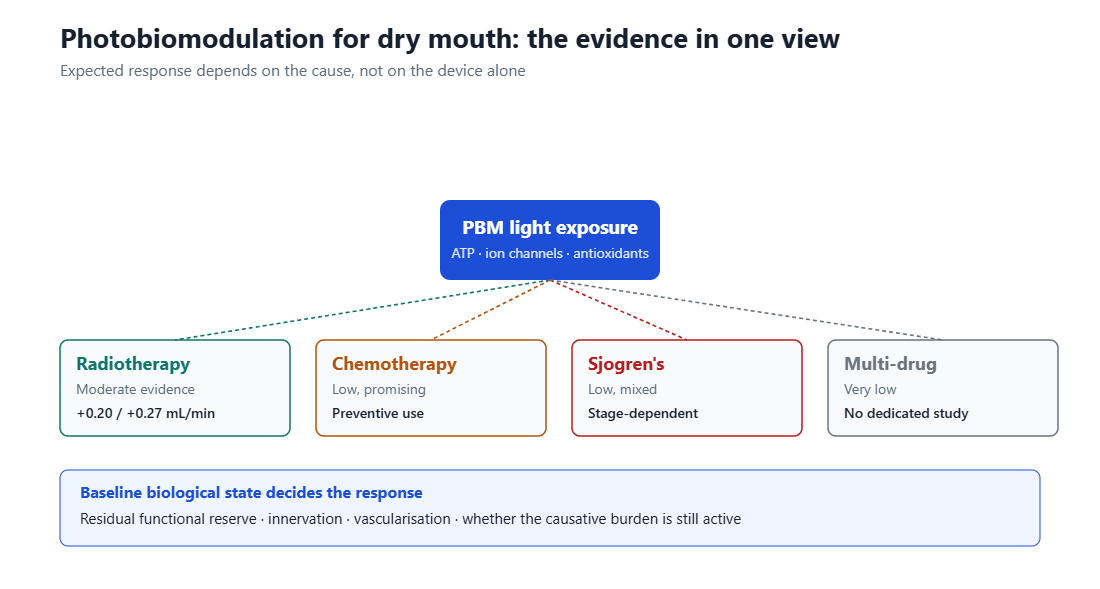
The honest version: PBM helps some patients with dry mouth, and which patients respond is largely set by the underlying cause. A 2026 narrative review in Lasers in Medical Science pooled evidence across four causes of salivary dysfunction. Outcome depends on how much functional gland tissue remains, how reversible the damage is, and whether the disease is still active.
Quick answer: PBM has its strongest evidence in radiotherapy-induced dry mouth, where meta-analysis shows an average gain of roughly +0.20 mL/min unstimulated and +0.27 mL/min stimulated salivary flow. Evidence for chemotherapy-related dry mouth is thinner but promising; for Sjögren's disease it is mixed; for multi-drug dry mouth it is essentially absent. Different causes therefore require different device setups and outcome measures.
1. Why the cause of dry mouth decides the answer
Short answer: dry mouth is a shared endpoint, not a disease. Different causes reach it through different paths, and PBM can only work on tissue that is still alive and connected.
Patients describe the same symptom; the biology behind it is not. The review separates four causes that converge on low saliva:
- Sjögren's disease: autoimmune, with lymphocyte infiltration and chronic inflammation. Fibrosis develops over time in some patients and is effectively irreversible.
- Chemotherapy-related: around 40% of chemotherapy patients report dry mouth, largely tied to oxidative stress from agents such as 5-fluorouracil and cisplatin. Damage is functional and reversible, with gland structure preserved.
- Radiotherapy-related: roughly 90% of head-and-neck radiotherapy patients are affected. Glands are highly radiosensitive — at around 10 Gy, flow already falls by nearly 50%, and after a full course above 60 Gy it can drop below 20% of baseline.
- Multi-drug: the combined anticholinergic load of antidepressants, antihypertensives, antipsychotics and diuretics blocks nerve-to-gland signalling. Structure is preserved early, but the cause persists.
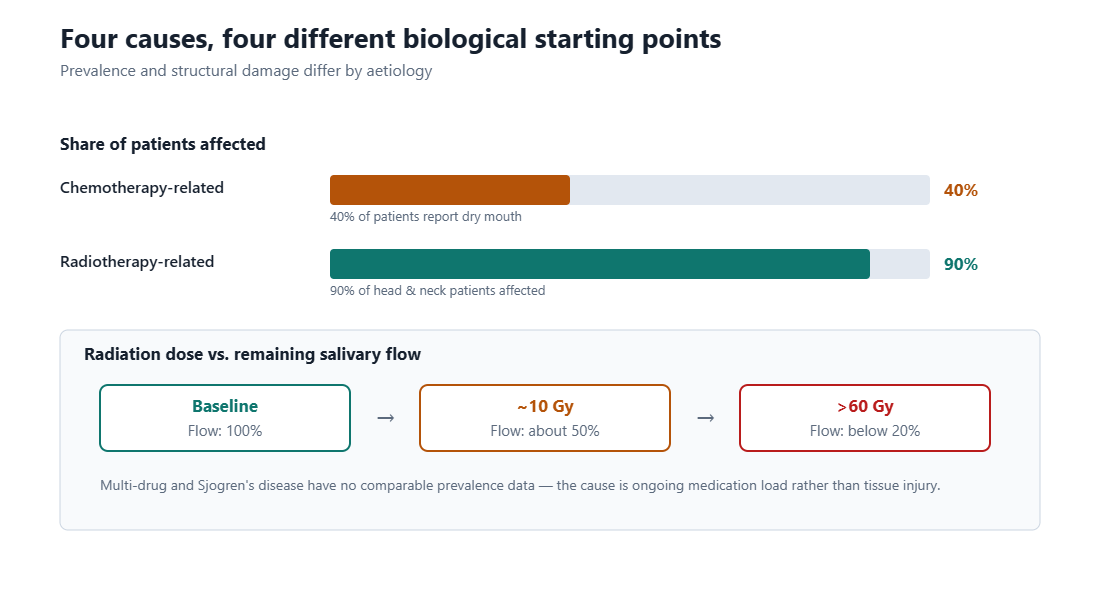
Read across that list and the review's central framework becomes clear. Response depends on the gland's baseline biological state: residual functional reserve, innervation, vascularisation, and whether the causative burden is still running. The model is hypothesis-generating: it maps expectations rather than promising outcomes.
2. How PBM works, and where it stops
Short answer: PBM acts through several pathways at once, and all of them depend on functional tissue being present.
Light absorbed by mitochondrial chromophores increases ATP production and cellular energy metabolism. PBM also modulates ion channels and membrane permeability, supporting fluid transport and secretion; down-regulates pro-inflammatory mediators and oxidative stress while activating endogenous antioxidant pathways; and improves microcirculation and tissue repair.
Every step needs living, connected, perfused gland tissue — precisely what separates a chemotherapy patient from a radiotherapy patient from a fibrosed Sjögren's gland.
3. What the evidence actually shows, cause by cause
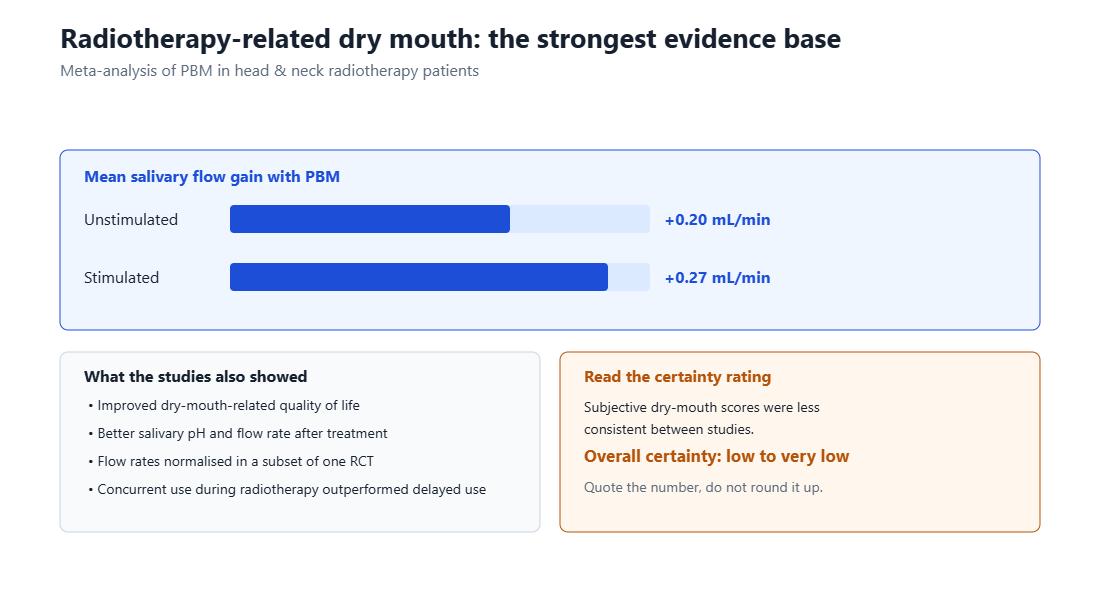
Radiotherapy-related dry mouth has the strongest evidence base. A meta-analysis found PBM raised unstimulated salivary flow by about 0.20 mL/min and stimulated flow by about 0.27 mL/min in head-and-neck radiotherapy patients. Subjective scores were less consistent and certainty was rated low to very low — quote that precisely rather than rounding up. Patients who have finished radiotherapy may still benefit: reported outcomes include better quality of life, salivary pH and flow rate, and in one randomised placebo-controlled trial normal flow returned in a subset. Notably, applying PBM during radiotherapy appears more beneficial than waiting until treatment ends.
Chemotherapy-related dry mouth has less clinical research but encouraging early results. Animal work shows protective effects on damaged glands, and preventive use during chemotherapy reduced dry-mouth severity.
Sjögren's disease has limited and mixed evidence. Case reports show symptom and flow-rate improvement, and a placebo-controlled pilot trial of laser acupuncture found significantly increased saliva production. But a randomised controlled trial found no significant improvement in scores or flow rate — an inconsistency plausibly linked to disease stage and fibrosis extent.
Multi-drug dry mouth is close to a blank space, with no dedicated clinical study in severe dry mouth driven by high anticholinergic burden.
| Cause | Main mechanism | Reversibility | Expected response | Evidence level |
|---|---|---|---|---|
| Chemotherapy-related | Oxidative stress | Mostly reversible | Fairly good | Low |
| Sjögren's disease | Infiltration, fibrosis | Partly reversible | Highly variable | Low |
| Radiotherapy-related | Acinar loss, fibrosis | Mostly irreversible | Limited; preventive value | Moderate |
| Multi-drug | Blocked signalling | Etiology-dependent | Unclear | Very low |
4. Why treatment success is not a restored flow rate
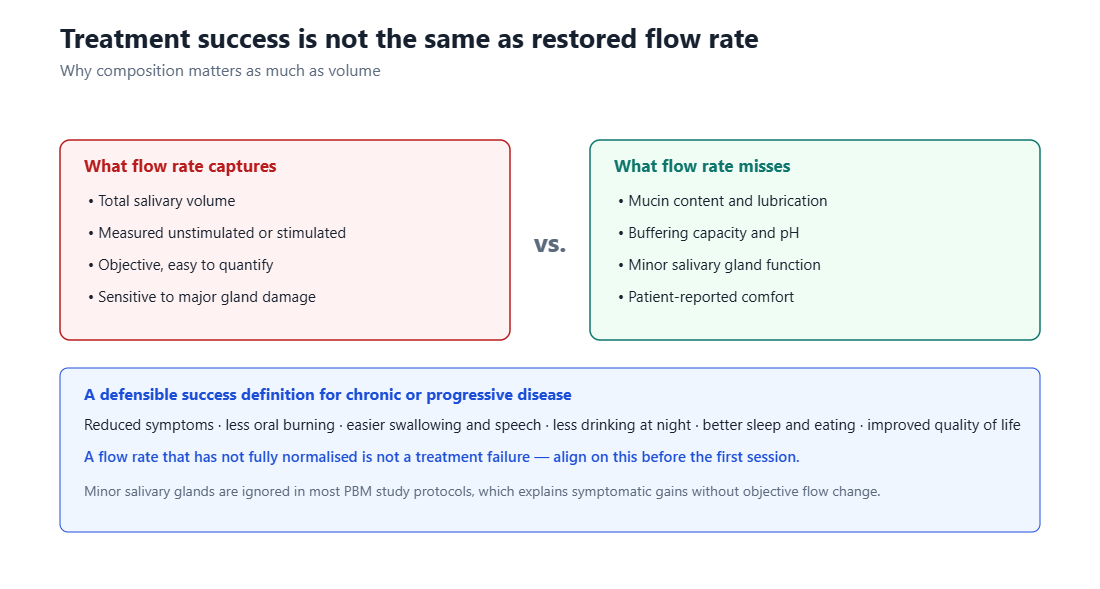
Short answer: symptoms and measured flow rate only partly correlate. Saliva quality matters as much as quantity — the point most easily missed. Composition (mucins, buffering capacity, pH) counts as much as volume. Minor salivary glands add little total flow, but their mucin-rich secretions are essential for mucosal lubrication, and most PBM protocols ignore them. That gap explains why patients report clear symptomatic improvement while objective flow barely moves.
For chronic fibrotic or progressive disease, success may mean reduced symptoms, less oral burning, easier swallowing and speech, less need to drink at night, and better sleep, eating and quality of life. A flow rate that has not fully normalised is not a failure.
5. What this means for device selection
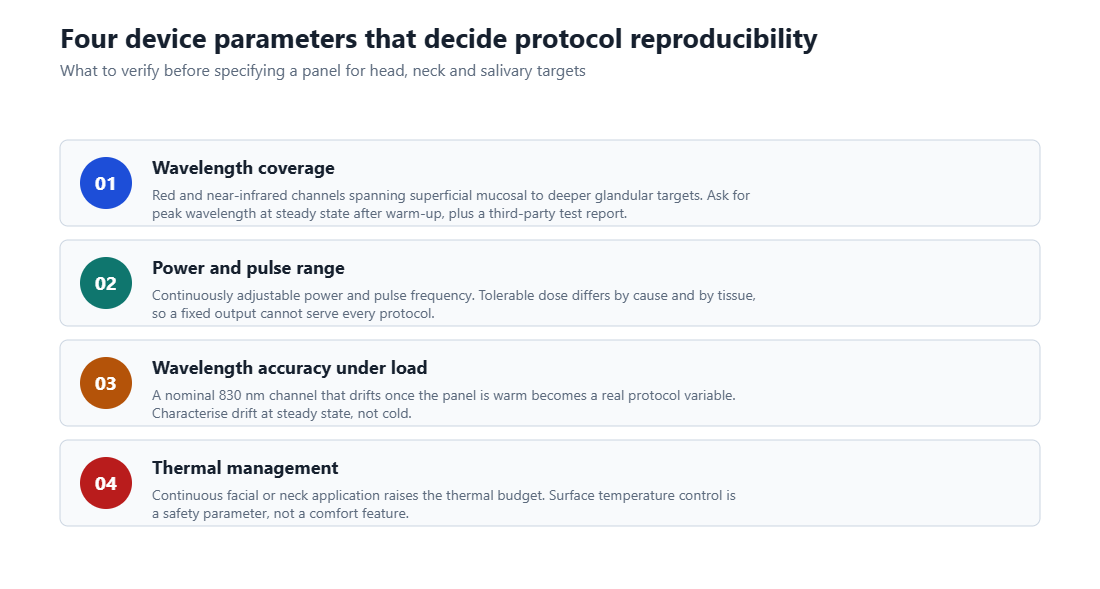
Dry mouth protocols target the head, neck and salivary region, not the torso, so the device must deliver controllable energy to a small, sensitive target.
- Wavelength coverage across red and near-infrared. Multi-wavelength output moves a protocol between superficial mucosal and deeper glandular targets. See our LED chip selection and IQC board testing guide.
- Power adjustment and pulse frequency range. Dose must be tunable, since tolerable dose differs by cause and tissue. See the near-infrared PBM helmet specification.
- Peak wavelength accuracy under load. A nominal 830 nm channel that drifts once the panel is warm is a real protocol variable, quantified in our note on wavelength thermal drift in red light therapy panels.
- Thermal management. Continuous facial or neck use raises the thermal budget, so surface temperature control is a safety parameter, not a comfort feature.
Multi-wavelength panels such as the 660 nm / 850 nm light therapy panel and zone-targeted PBM helmets suit localised protocols; full-body options are covered in our full-body red and near-infrared light bed. For oral or perioral work, zone-targeted fits better than a full-body bed.
Buyer checklist — four questions for any supplier
- What is the peak wavelength of each channel, measured at steady state after warm-up, and is a third-party test report available?
- What is the delivered irradiance at the working distance you will actually use, and at what power setting?
- What is the power adjustment range and the pulse frequency range, and are both continuously variable?
- What is the measured panel surface temperature during continuous operation at maximum output?
6. What the review does not settle
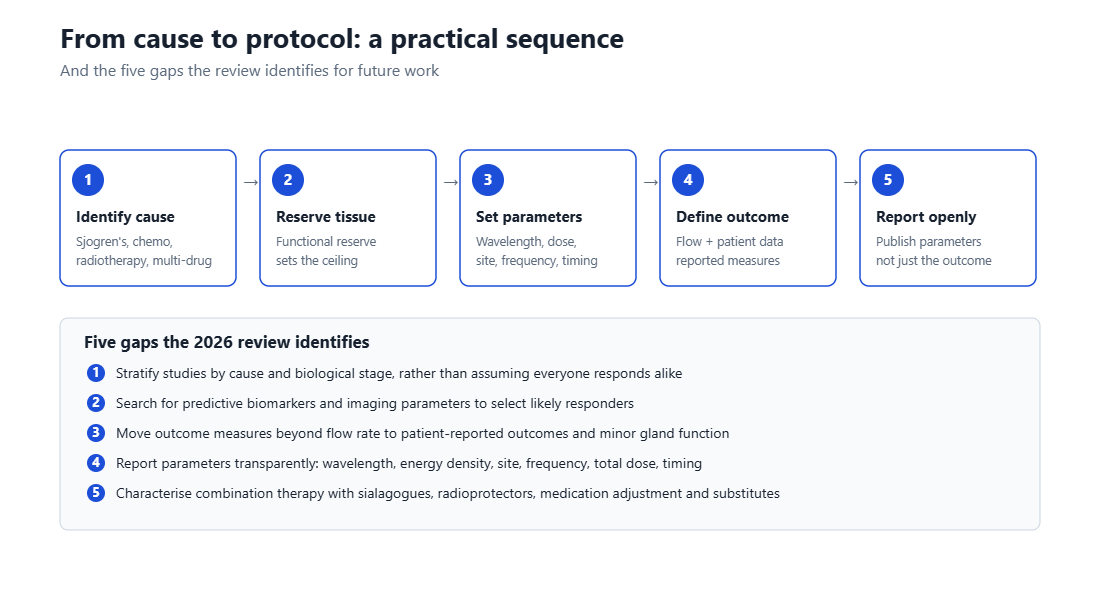
The review is explicit about its own limits, and so should any supplier be. Five gaps stand out: stratify studies by cause and biological stage instead of assuming everyone responds alike; develop predictive biomarkers; move beyond flow rate to patient-reported outcomes; report wavelength, energy density, site, frequency, total dose and timing transparently; and characterise combination approaches.
For now the takeaway is simpler: match the device to the cause, define the outcome before treatment starts, report parameters openly.
FAQ
Q: Can PBM cure dry mouth?
No cure is claimed or supported. The review maps expected responses by cause and describes PBM as adjunctive, with condition-specific and often limited evidence.
Q: Which cause has the best evidence?
Radiotherapy-related dry mouth, where meta-analysis shows a mean gain of about 0.20 mL/min unstimulated and 0.27 mL/min stimulated flow. Certainty is still rated low to very low.
Q: Why did my patient improve subjectively but not on flow measurement?
Symptoms and flow rate only partly correlate. Saliva composition, particularly minor gland mucin secretion, contributes to comfort in ways flow metrics do not capture.
Q: Is a multi-wavelength panel necessary?
Not strictly, but it lets a protocol adapt across superficial mucosal and deeper glandular targets without changing hardware.
Dry mouth is not one condition with one answer, and the device is not the variable that decides the outcome. The biology of the cause sets the expectation; panel parameters decide whether you can hit it reproducibly. More engineering notes sit on the Suyzeko blog index, and our 21-channel PBM design note covers zone-targeted delivery.
Contact Suyzeko for panel specifications, wavelength configuration and OEM/ODM enquiries.
Disclaimer: This article summarises published research for technical and educational purposes. It is not medical advice and does not claim any therapeutic outcome. Cited figures come from published literature and may not apply to every case. Device parameters are subject to the final technical specification and quotation. Always follow professional guidance and local regulations when using photobiomodulation equipment.
 Does 840 nm Outperform 600 nm in Transcranial PBM? Five-Week Data on Oxidative Stress and Complex IV