

 Home
Does 840 nm Outperform 600 nm in Transcranial PBM? Five-Week Data on Oxidative Stress and Complex IV
 Suyzeko
 Nov 23,2026

Does 840 nm Outperform 600 nm in Transcranial PBM? Five-Week Data on Oxidative Stress and Complex IV
A 2026 rat study compared two transcranial photobiomodulation wavelengths on behavior, oxidative-stress markers and mitochondrial function — and the two did different jobs.
Specifying a transcranial photobiomodulation (tPBM) helmet starts with the same question: red or near-infrared? Buyers want one wavelength that wins everywhere. A 2026 Neurochemical Research study suggests a better answer — two wavelengths reversed the same behavior through partly different biology.
The study used a chronic mild stress (CMS) rat model of anhedonia-like behavior, delivered 600 nm or 840 nm light to the forehead for five weeks, and measured sucrose intake, peripheral oxidative stress, hippocampal nitric oxide (NO) and prefrontal cortex (PFC) mitochondrial complex IV (cytochrome c oxidase, CCO) activity.
This is a preclinical animal study, not human clinical evidence. Read the numbers as mechanism and parameter guidance for device design — not as proof that any device treats depression.
1. What did the study actually test?
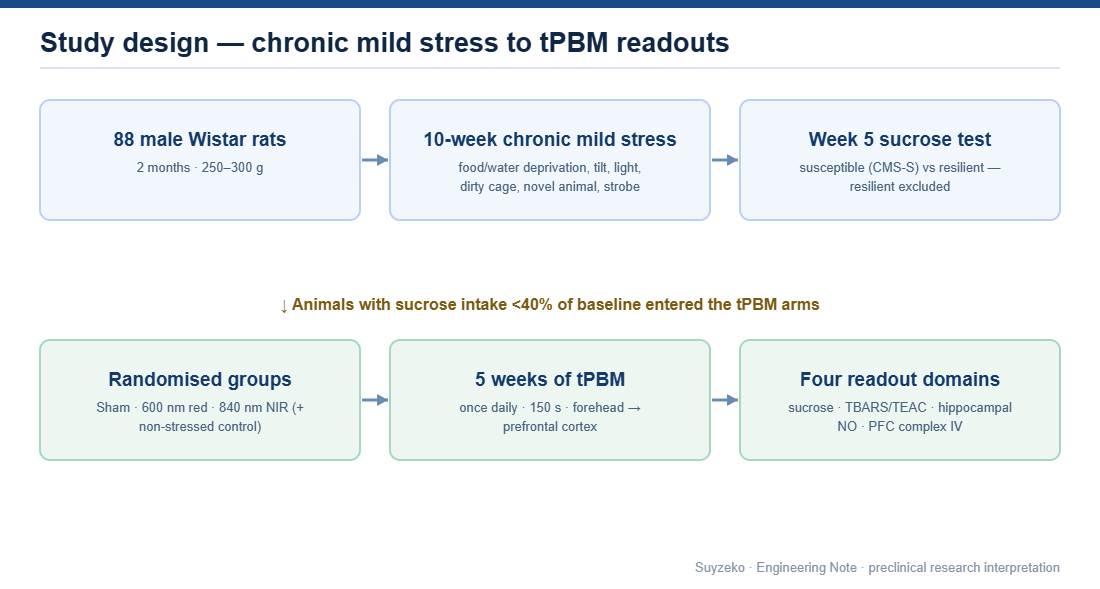
Short answer: 88 male Wistar rats, ten weeks of chronic mild stress, then five weeks of daily tPBM targeted at the prefrontal cortex.
Rats were 2 months old (250–300 g). After 14 days of habituation and sucrose-baseline training, ten weeks of CMS alternated food/water deprivation, tilted cages, intermittent light, dirty cages, novel animals and strobe. At week 5, intake below 40% of baseline defined susceptible rats (CMS-S); resilient animals were excluded. Susceptible rats were balanced by sucrose intake and assigned to sham, 600 nm or 840 nm tPBM, plus a non-stressed control. Light was applied to the forehead daily for five weeks.
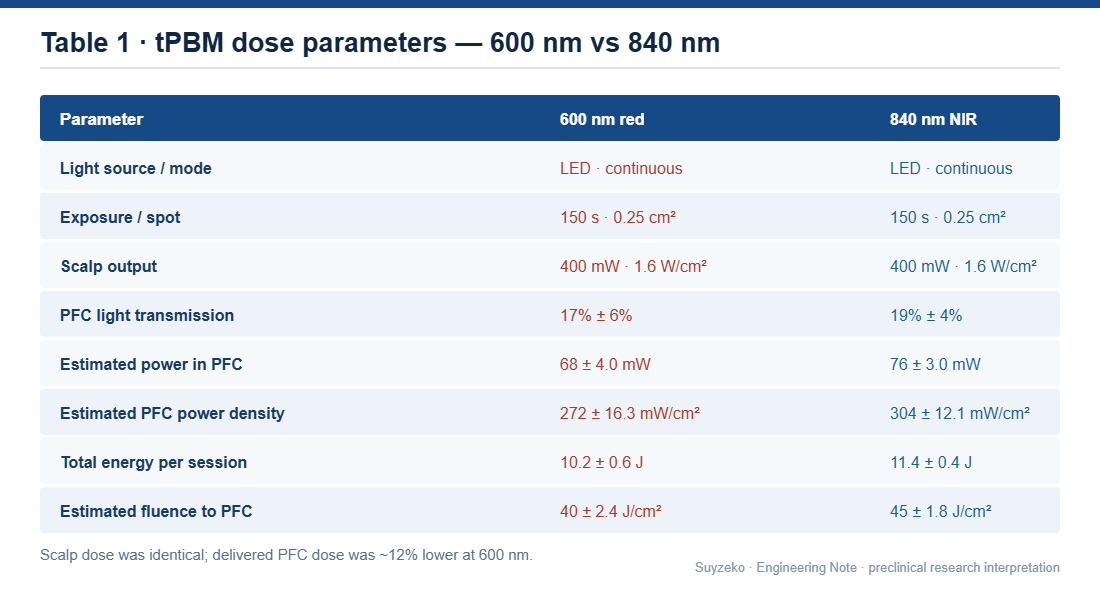
Dose reporting is unusually complete. Both arms used continuous-wave LEDs, 150 s per session, a 0.25 cm² spot and 400 mW total output — 1.6 W/cm² at the scalp. Estimated light reaching the PFC was only 68 ± 4.0 mW (600 nm) and 76 ± 3.0 mW (840 nm), or 272 and 304 mW/cm²; estimated PFC fluence was 40 and 45 J/cm².
On depilated skull-with-scalp samples, transmission was 17% ± 6% (600 nm) and 19% ± 4% (840 nm), versus 9% ± 3% and 10% ± 2% with fur; no significant skin heating occurred. Small scalp differences compound across the dose stack — see section 5.
2. Did tPBM reverse anhedonia-like behavior?
Short answer: Yes — both wavelengths did, while the sham group remained anhedonic.
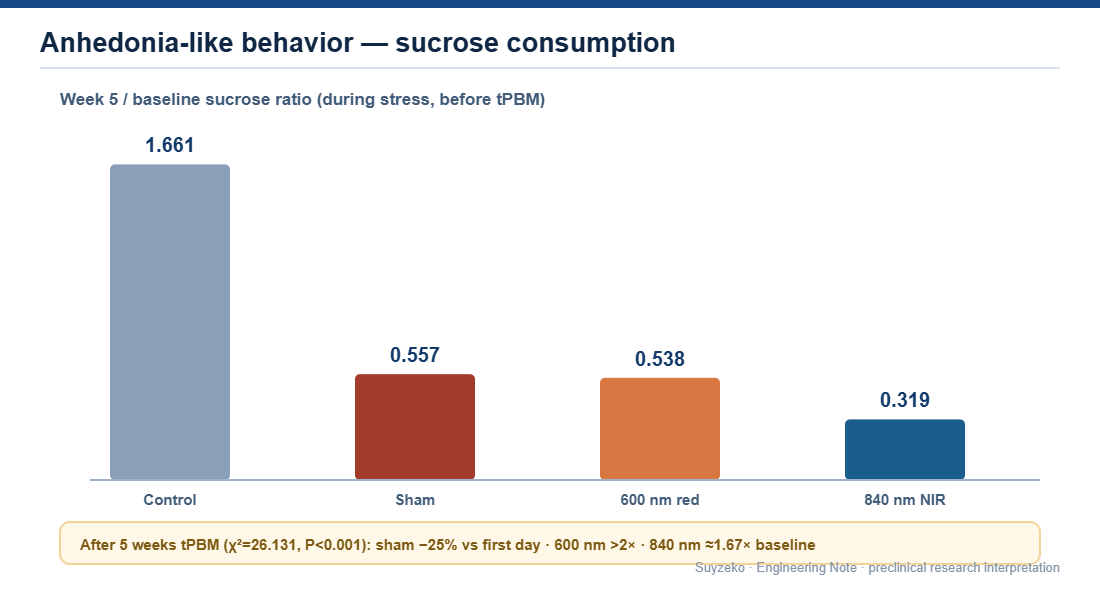
Sucrose consumption was the behavioral readout: rats trained on 1% sucrose, bottles weighed before and after each test. Baseline intake did not differ (Kruskal-Wallis, P = 0.123). By stress week 5, sham, red and infrared groups all drank less than controls (P = 0.0574); versus baseline, sham fell over 55% and both light groups about 67%, confirming the model.
After five weeks of tPBM the groups separated (Kruskal-Wallis χ² = 26.131, P < 0.001): sham stayed 25% below its first treatment day, 600 nm more than doubled intake, and 840 nm recovered to about 1.67 times baseline. Sucrose intake is a rodent proxy for anhedonia-like behavior, not a human mood score — but within the model both wavelengths produced a clear reversal.
3. Oxidative stress: the 600 nm signal
Short answer: Red light lowered peripheral lipid peroxidation; neither wavelength significantly moved total antioxidant capacity.
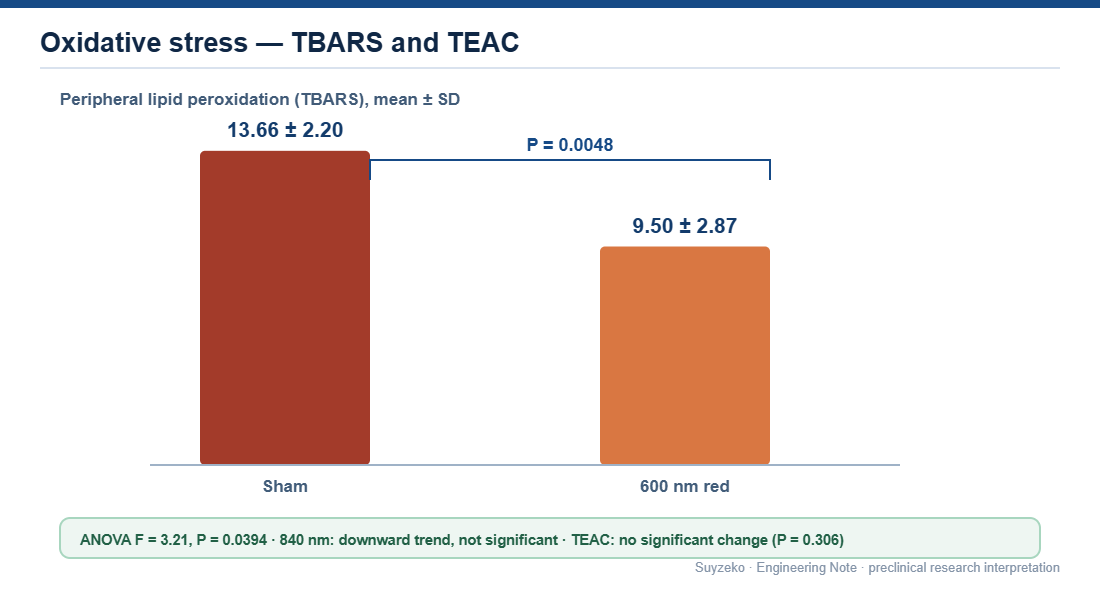
Lipid peroxidation was measured in peripheral blood as TBARS, and total antioxidant capacity as TEAC by ABTS⁺ scavenging. One-way ANOVA found a significant group effect on TBARS (F = 3.21, P = 0.0394). The 600 nm group averaged 9.50 ± 2.87, significantly below the sham group's 13.66 ± 2.20 (P = 0.0048) and close to the non-stressed control. The 840 nm group trended downward but did not reach significance.
TEAC told a different story: total antioxidant capacity in both light groups was numerically above sham and control, but not significant (P = 0.306). The red-light effect here is specific to a lipid-peroxidation marker, not a broad antioxidant readout — a distinction generic "red light reduces oxidative stress" claims blur.
4. NO and complex IV: where 840 nm pulled ahead
Short answer: Near-infrared raised hippocampal NO and was the only group to increase prefrontal complex IV activity.
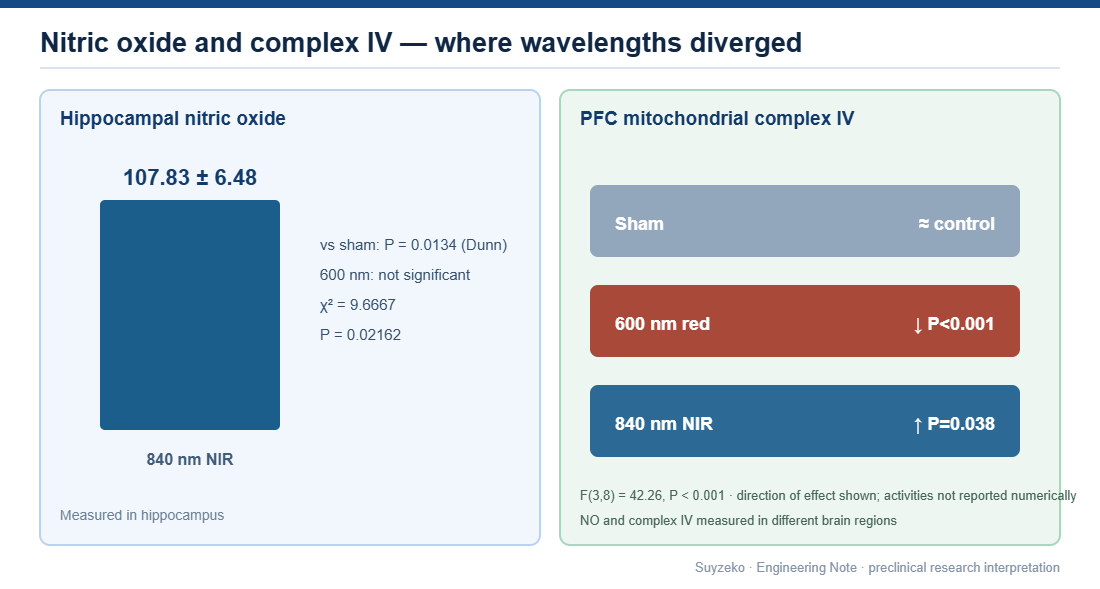
Hippocampal NO (Griess method) differed across groups (Kruskal-Wallis χ² = 9.6667, P = 0.02162). The 840 nm group averaged 107.83 ± 6.48, above sham (Dunn P = 0.0134); 600 nm showed no significant difference. PFC complex IV also differed (F(3,8) = 42.26, P < 0.001). Sham and control did not differ. The 600 nm group was significantly lower than control and sham (P < 0.001 each), while 840 nm was higher than every other group (vs control P = 0.038; vs sham and 600 nm P < 0.001).
That is the paper’s most counterintuitive finding: at these doses, red suppressed PFC complex IV while near-infrared stimulated it. NO and complex IV were measured in different brain regions, so the authors caution effects may be region-specific — a hypothesis-generating signal, not a settled mechanism. Wavelength accuracy matters here; see our note on LED wavelength thermal drift in red light therapy panels.
5. What this means for tPBM hardware and buyers
Short answer: Treat wavelength as one variable in a parameter space, not a single winning spec.
The authors list dose optimization as a limitation: wavelength, power, continuous vs pulsed mode, power density, exposure time, J/cm², total energy and session spacing were not varied. Four questions follow for device buyers:
- Ask for the full dose stack. This study delivered 400 mW at the scalp but only an estimated 68–76 mW at the PFC (40–45 J/cm²). Ask what reaches the target, not what leaves the LED.
- Ask whether channels can be controlled independently. Red and near-infrared acted on different markers in different regions. A single uniform field cannot explore that parameter space.
- Ask for frequency, duty cycle and power range. If the science has not settled continuous versus pulsed delivery, a fixed-output device locks the user into one untested setting.
- Ask for thermal and optical measurements. No significant skin heating occurred here at 1.6 W/cm², but verify per device. Our guides to LED chip selection and IQC board testing and PBM device parameter reporting cover the checks.
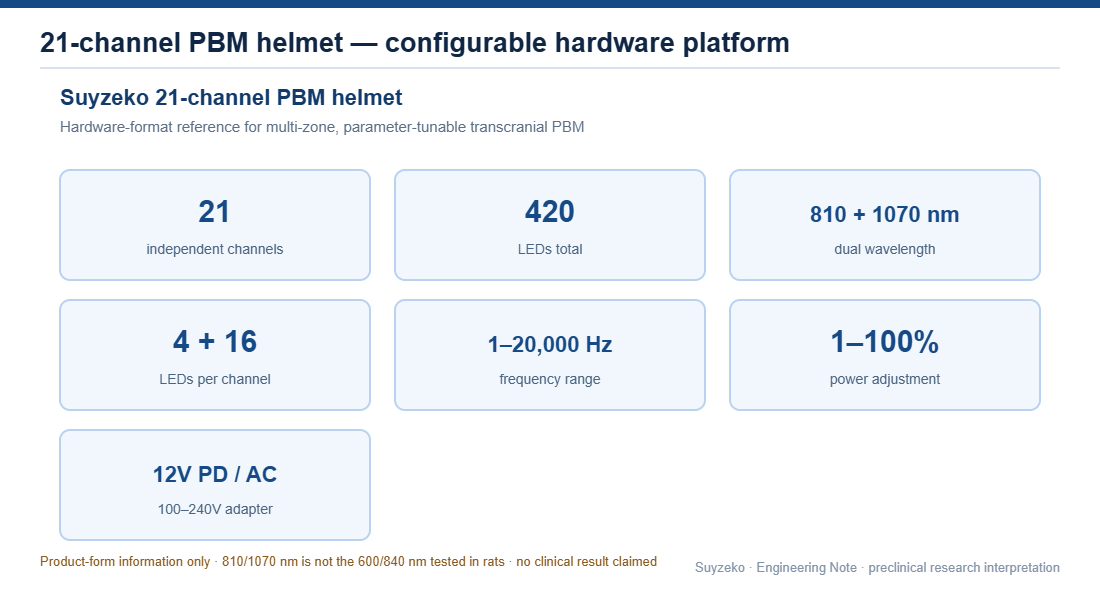
For teams designing around those variables, the Suyzeko 21-channel PBM helmet is a hardware-format reference: 21 independent channels, 420 LEDs, 810 nm + 1070 nm, 1–20,000 Hz, 1–100% power. See also our 21-channel PBM brain-health overview and 810 nm brain phototherapy background. Product-form information only: this device uses 810/1070 nm, not the rats’ 600/840 nm, and no result is claimed.
FAQ
Does this prove tPBM treats depression in humans?
No. It is a chronic mild stress study in male rats. It supports further parameter research; it is not clinical evidence for any human indication.
Why did 600 nm lower TBARS but 840 nm raise NO and complex IV?
The markers came from different compartments — peripheral blood, hippocampus and PFC — and the authors suggest effects may be region-specific. The study did not measure inflammation markers directly, so the mechanism is not established.
Is near-infrared simply the better wavelength?
For most endpoints in this study, 840 nm was equal or superior and the authors recommend prioritizing it. But 600 nm had a distinct effect on peripheral lipid peroxidation that near-infrared did not reach significance on.
Can I map the 600/840 nm results onto an 810/1070 nm helmet?
No. Different wavelengths, different delivery geometry and different species. Use the paper to frame questions about dose reporting and channel control, not to predict outcomes.
Final thoughts
The message is not "red wins" or "near-infrared wins". Two wavelengths 240 nm apart changed the same behavior through different biology at the same nominal power. Wavelength, channel control and delivered dose are engineering questions — not marketing adjectives.
For specification sheets, sample testing or a custom multi-wavelength configuration, contact the Suyzeko technical and sales team. More engineering notes are in the Suyzeko Blog.
Reference: Bertolucci L, Colombo R, Pinto KBM, et al. Neurochemical Research. 2026;51:83. DOI: 10.1007/s11064-026-04681-2.
Disclaimer: This article is an interpretation of a preclinical animal study and is provided for technical and educational information only. It is not medical advice and makes no treatment claim for any product. Suyzeko devices are physical-therapy and wellness equipment; specifications, certifications and delivery terms are those stated in the final technical agreement and quotation. Products must be used under qualified professional guidance and in line with local regulations.
 Can Photobiomodulation Really Treat Dry Mouth? What the 2026 Evidence Says About Cause, Outcome and Device Setup